How to Calculate the ROI of AI Message Filtering
Not a vibe — a subtraction you can do on one line.
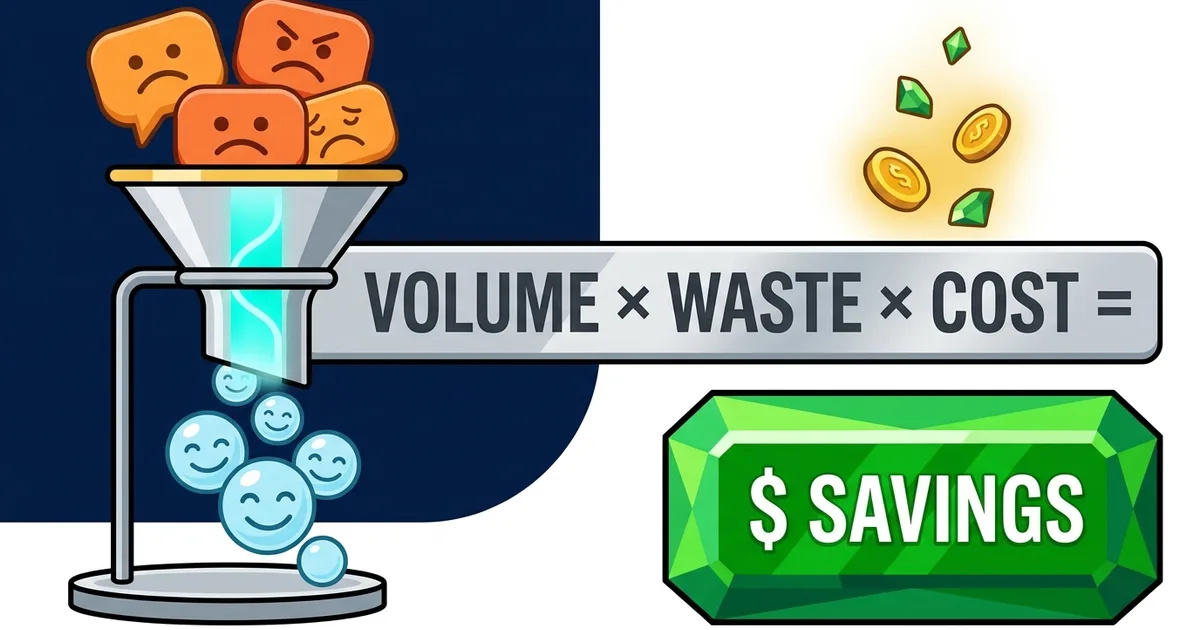
- Savings = V × W × C; measure W from ~500 real messages, not a guess.
- A defensible planning range for combined waste is 30–45%.
- Savings scale linearly with volume; a DIY filter’s cost stays near flat.
The problem
- Filtering junk sounds obviously worth it — until finance asks for a number.
- Your agent is billed twice per message: a platform execution and LLM tokens.
- Neither bill cares whether the message was worth answering.
The solution
Four numbers you can pull from your own billing, one subtraction:
- Savings = V × W × C (volume × waste rate × blended cost/run).
- ROI = (savings − F) ÷ F × 100 (F = filter cost).
- Measure W from ~500 real messages — never a generic percentage.
Blend tokens and executions into C — on a chatty agent, tokens are the larger bill.
Result: a number you can put in front of finance, not a sales-deck estimate.
Filtering junk before it reaches your AI agent sounds obviously worth it — until finance asks for a number. The ROI of AI message filtering is not a vibe; it’s a subtraction you can do on one line. This post gives you the formula, a worked projection, and the caveats that keep it honest.
What the ROI of AI message filtering actually measures
ROI here is the money you stop spending on messages that were never a real question. Three traffic types inflate both bills without adding value: duplicates (retries read two or three times), bursts (“hi” / “can you” / “help me” as four messages for one intent), and junk (bots and malformed payloads). Filtering removes that traffic before it costs anything — the ROI is simply what that removed traffic would have cost.
The formula
You need four inputs, all from your own billing:
| Variable | What it is | Where to find it |
|---|---|---|
V | Inbound messages per month | Channel / webhook logs |
W | Waste rate (duplicates + bursts + junk) | Sample ~500 messages and count |
C | Blended cost per agent run (execution + tokens) | Platform bill ÷ runs |
F | Monthly cost of the filter | Gateway plan, or ~$0 for a DIY worker |
Monthly savings = V × W × C ROI = (savings − F) ÷ F × 100
That’s the whole model. Everything else is sourcing honest numbers for the four variables.
A worked projection
The figures below are a projection, not a measured study. They apply the duplicate, burst, and junk rates documented across this message-quality cluster — roughly 43% combined waste once bursts are merged — to two agent sizes. Cost per run blends a platform execution ($0.002) with a typical token flood-free call on public OpenAI pricing ($0.004), so C ≈ $0.006.
| Startup agent | Scaling agent | |
|---|---|---|
Volume V | 10,000/mo | 100,000/mo |
Waste W | 43% | 43% |
Cost/run C | $0.006 | $0.006 |
| Monthly savings | ~$26 | ~$258 |
| Annualized | ~$310 | ~$3,100 |
The headline is the slope, not the single number: savings scale linearly with volume, while a DIY filter’s cost stays near flat. At 10k messages the win is modest; by 100k it funds itself many times over. The one input people get wrong is C — a blended run cost that ignores tokens undercounts savings badly.
Measure your real waste rate first
W is the only input worth measuring before you trust the output. Pull your last ~500 inbound messages and tag each as clean, duplicate, burst fragment, or junk:
- Count duplicates — identical payloads within a short window. See how deduplication catches them.
- Count burst fragments — messages from one sender seconds apart that form a single intent.
- Count junk — bot traffic and malformed payloads.
- Sum them, divide by 500. That ratio is your
W— use it instead of the 43% projection.
Across duplicate, burst, and junk traffic, 30–45% is a defensible planning range, but channels like WhatsApp skew higher on bursts. And remember: filtering in front of the platform lowers both the token and execution bills; filtering inside saves only tokens, because the execution is already counted — the difference is in cutting n8n agent costs.
A gateway in front of your agent is what removes the waste that makes the number worth calculating — one more piece of message quality for AI agents.
If the number works for you, here’s the short version of how to set it up: stop paying to read the junk →.
Either way — go pull your four numbers and run the subtraction.
Thanks for reading. 👋
Orlando. -
Orlando Quijada
Technologist with 15+ years of experience. Developer, SaaS tester, and AI collaboration & optimization specialist. Currently contributing at portarus.com.
Written on