5 Hidden Costs of an AI Agent Without Filtering
The API bill is the tip. Four bigger costs sit below it.

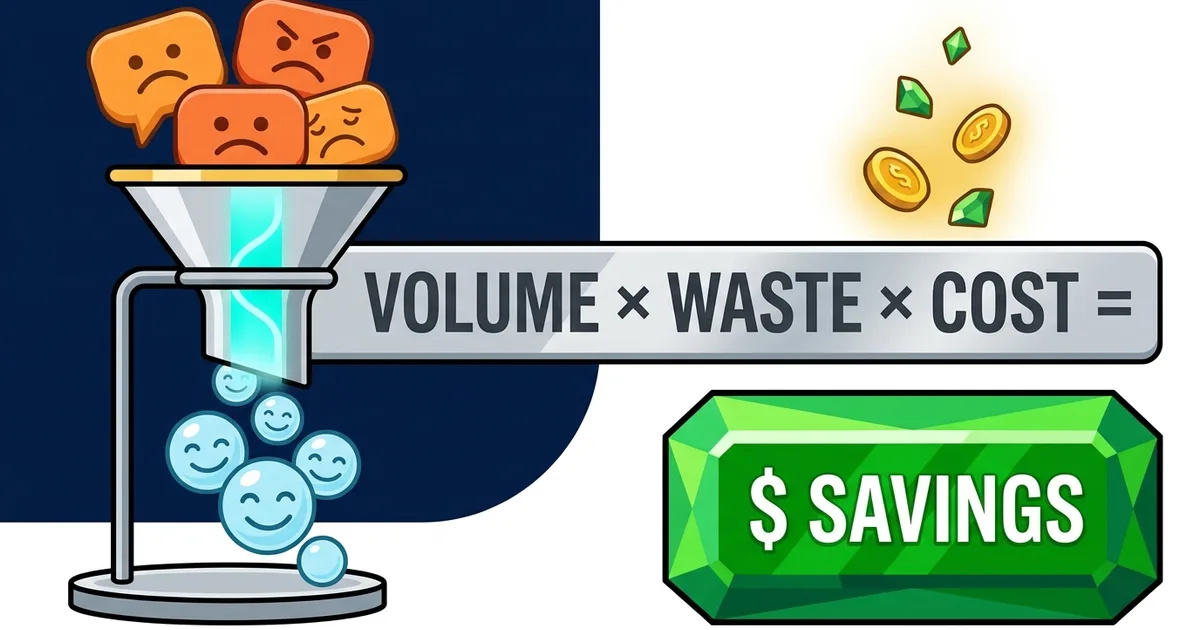
- 45% duplicates/fragments = nearly half your runs aren’t real conversations.
- At $0.01/run × 50k/mo that’s ~$225/mo on messages that never needed an agent.
- Only 1 of 5 costs is the API bill you budgeted for.
The problem
- Founders budget for the API bill — the cost above the waterline.
- Four more hide below: wasted runs, reprocessed context, incident time, churn.
- They land in different teams' numbers, so they go unnoticed until the total hurts.
The solution
Input filtering drops the junk upstream, so the agent only processes real, complete intents — and four of these five costs shrink at once.
- Drop duplicates and reject bots.
- Merge fragmented bursts into one intent.
- Cap oversized payloads before the model.
Measure your duplicate and fragment rate for a week — that single number sizes four of the five costs.
Result: hidden costs become ones you control.
When founders budget for an AI agent, they budget for the API bill. That’s the cost above the waterline. The hidden costs of running an AI agent without input filtering are the five sitting underneath it — the ones that don’t show up in the OpenAI dashboard but quietly eat your margin. Here is each one, with a number you can plug into your own math.
1. Wasted executions you still pay for
Every duplicate and fragment that reaches your agent triggers a full run you’re billed for. On n8n and Make, that’s an execution or a stack of operations; on your own stack, it’s compute and an LLM call. If 45% of inbound messages are duplicates or burst fragments — common on chat channels — then nearly half your runs aren’t real conversations at all. At a conservative $0.01 a run and 50,000 runs a month, that’s $225/month on messages that never needed an agent.
2. Token overspend on oversized inputs
A single bloated message costs far more than a normal one. A 50K-token paste or a forwarded thread can cost as much as fifty short messages — and without filtering, it goes straight to the model at full price. You don’t need many: one token flood a day can outspend thousands of normal messages over a month.
3. Context reprocessing on fragments
Fragmented messages don’t just cost extra executions — they cost extra context. When “hi”, “can you”, and “help me cancel” arrive as three messages, the agent often reprocesses the growing history on each one, re-reading the same tokens two and three times. A conversation that should cost one pass costs three, and it scales with how chatty your users are.
4. Incident response time
Unfiltered input is where the 3am pages come from. A retry storm, a looping integration, or a bot all land directly on the agent with nothing in front to absorb them. The cost here isn’t tokens — it’s an engineer’s night and the hours spent tracing why the bill spiked. One incident a quarter at a few hours of senior time is a real line item, invisible until it happens.
5. Churn from slow, degraded answers
When the agent is busy processing junk, real users wait. Fragmented input also means the agent answers half a thought — replying to “hi” before “help me cancel” arrives — so the response is worse, not just slower. Slow and wrong is how trial users decide not to convert, and one churned paying user can erase the entire month’s “savings” from skipping filtering.
The five, in one view
| Hidden cost | Shows up as | Who feels it |
|---|---|---|
| Wasted executions | Extra runs / operations billed | Finance |
| Token overspend | Spiky API bill | Finance |
| Context reprocessing | Same tokens paid 2–3× | Finance |
| Incident response | Engineer hours, night pages | Engineering |
| Churn | Lost conversions | Growth |
Unfiltered vs filtered in front
Input filtering is cleaning the message stream before the agent sees it — dropping duplicates, merging bursts, capping oversized payloads, rate-limiting abuse. Where you put it decides how many of the five costs it removes:
| No filtering | Filter in front (gateway) | |
|---|---|---|
| Wasted executions | ✕Billed in full | ✓Never triggered |
| Token overspend | ✕Floods hit the model | ✓Capped before the LLM |
| Context reprocessing | ✕Paid 2–3× | ✓One merged pass |
| Incident time | ~Lands on the agent | ✓Absorbed at the edge |
| Churn risk | ~Slow, half answers | ✓One clean intent |
Filtering the input before it reaches the agent, with a filter layer in front of the LLM, turns those hidden costs back into ones you control. It’s the practical side of message quality for AI agents.
If a filter in front sounds like you, here’s the short version of how to set it up: put the five costs back under your control →.
Either way — go count your duplicate and fragment rate for a week.
Thanks for reading. 👋
Orlando. -
Orlando Quijada
Technologist with 15+ years of experience. Developer, SaaS tester, and AI collaboration & optimization specialist. Currently contributing at portarus.com.
Written on