How to Reduce n8n Executions (and Your Bill)
The cheapest execution is the one that never starts.
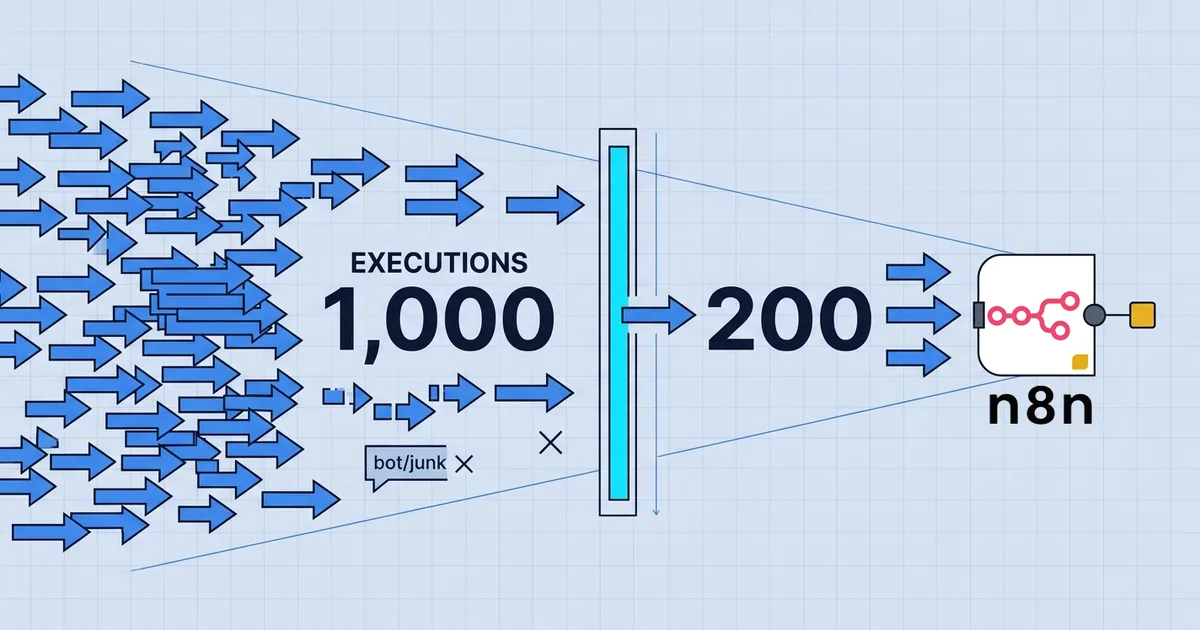
- The Webhook node counts an execution before any logic runs.
- Duplicates, bursts and bot probes all bill as full executions.
- Filtering in front makes the count track real traffic — up to ~43% fewer.
The problem
- n8n's Webhook node fires an execution the instant a request lands — before any logic runs.
- Retries, bursts and bot probes each trigger a full execution you pay for.
- Your usage graph runs ahead of your real traffic, and it never shows up as an error.
The solution
There are only two places to act, and they save different amounts:
- Inside n8n: filter after the Webhook node → saves the downstream work, not the execution.
- In front of n8n: filter before the Webhook URL → the execution never counts.
Drop duplicates, merge bursts into one, reject junk — so n8n triggers once per real event.
Result: your execution count finally tracks your actual traffic.
Your n8n bill scales with executions, not with real events. Every retry, every message a user splits across five bubbles, every bot probing your endpoint — each one is a full execution you pay for. The cheapest execution is the one that never starts. Here is how to reduce n8n executions without touching your actual workflow logic.
Why your execution count outruns your traffic
Three patterns inflate the count: duplicates (senders retry on timeout, so one event arrives two or three times), bursts (a user types “hi”, “can you”, “help me”, “with an order” as four messages — four executions for one intent), and junk (bots, scanners, and malformed payloads trigger the node before you can reject them). None of it shows up as an error, only as a usage graph running ahead of your real traffic.
The manual fix (Option 1)
Trim work inside n8n. Filter inside the workflow with an IF or Switch node right after the Webhook: drop duplicates with the Remove Duplicates node, reject messages that fail a validation check, and short-circuit the rest of the branch so the expensive nodes never run.
On a gateway, the request is dropped before the Webhook node ever fires.
The catch: inside n8n can’t move the execution line
The execution is counted at the edge, before your IF node runs — so no amount of in-workflow logic reduces the count itself, and you rebuild that logic in every workflow. To stop the execution from starting, the filter has to live in front of the Webhook URL.
Place a gateway layer (Option 2) — faster
A message gateway sits between the sender and your Webhook URL. You point senders at the gateway, and it drops duplicates, merges bursts into one message, and rejects junk before forwarding. Only clean, real events reach n8n — so n8n starts one execution per event, and your count tracks your actual traffic.
- The execution never starts. The duplicate, burst copy or bot is dropped at the edge.
- One layer, every workflow. No per-flow IF/Switch branch to rebuild.
- Tune, don’t code. Dedup window and limits are settings.
Option 1 (inside) vs Option 2 (in front)
| Filter inside n8n | Filter in front (gateway) | |
|---|---|---|
| Duplicate webhook | ~Downstream only | ✓Never triggers |
| Burst of fragments | ~One execution each | ✓Merged into one |
| Bot / junk request | ✕Still counted | ✓Rejected at the edge |
| Downstream cost (calls, writes) | ✓Saved | ✓Saved |
| Every workflow | ~Rebuild the branch each time | ✓One layer, all flows |
| Control of internals | ✓Full | ~Abstracted away |
Usually duplicates and bursts waste the most — deduplicating and merging fragments cut the count with no change to your logic. It’s one piece of message quality for AI agents.
If option 2 sounds more like you, here’s the short version of how to set it up: keep wasted triggers off your n8n bill →.
Either way — go make your execution count match your real traffic.
Thanks for reading. 👋
Orlando. -
Orlando Quijada
Technologist with 15+ years of experience. Developer, SaaS tester, and AI collaboration & optimization specialist. Currently contributing at portarus.com.
Written on